Fathima Najah
September 17, 2026
Built for Safety: Inside SAGA Certifications
Anybody can assert that a power product is secure. It is demonstrated by certification. A SAGA PowerTrack or adaptor must pass a number of independent, globally recognised criteria that regulate the sale and use of electrical devices before it is placed on a wall, desk, or kitchen counter. This is the true significance of those qualifications and the reason they are more important than they first seem.
IEC 60884-1: The Baseline for Plug and Socket Safety
The International Electrotechnical Commission standard IEC 60884-1, which regulates plugs and socket-outlets for domestic and comparable general usage, is used to test each SAGA adaptor. Dimensional correctness, resistance to mechanical stress, temperature rise under load, and insulating performance are all covered by this standard. It establishes if it is safe to produce and market a plug-and-socket connection at all.
SAGA adapters are tested for up to 10,000 insertions as part of this standard, which ensures that the twist-lock connection continues to function reliably even after thousands of uses, removals, and reuses. This is particularly important because SAGA's modular design relies on adapters being moved frequently rather than installed once and left alone.
CE Certification: Compliance Across the European Market
CE certification attests to a product's compliance with European rules' standards for environmental protection, health, and safety. This covers general product safety criteria, low-voltage safety requirements, and electromagnetic compatibility for an electrical product. SAGA products bearing the CE mark have been evaluated in accordance with all of these standards, not just one safety test.
FCC Certification: Controlling Electromagnetic Interference
FCC certification, which is granted in accordance with US Federal Communications Commission regulations, attests to the fact that a product's electromagnetic emissions remain within bounds that avoid interfering with other electronic devices. This is not a little thing for a power system that has integrated USB and Type-C charging hardware. Wireless peripherals, routers, and monitors in close proximity may be interfered with by poorly protected charging equipment. SAGA's internal electronics are protected and controlled to prevent that result, according to FCC certification.
RoHS Compliance: Restricting Hazardous Materials
The use of some hazardous elements, such as lead, mercury, and some flame retardants, in electrical and electronic equipment is restricted by RoHS, the Restriction of Hazardous Substances directive. Because SAGA products are RoHS compliant, the materials used during production adhere to environmental safety standards rather than the bare minimum required by law. This closely relates to SAGA's declared dedication to recyclable components and environmentally friendly materials.
The 1mm Probe Test
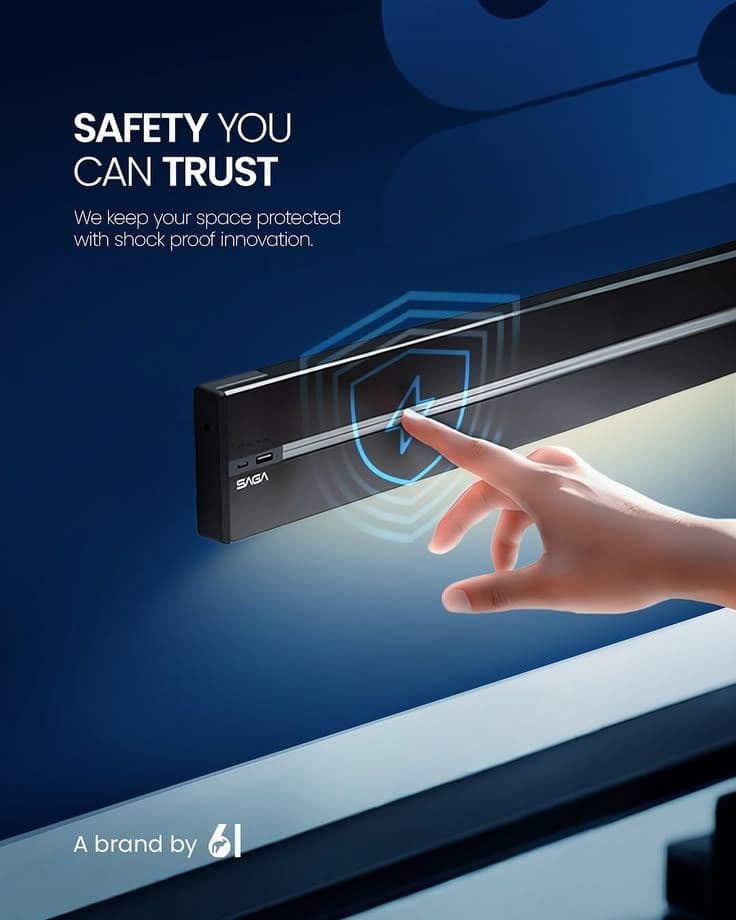
Every SAGA product is tested against a particular physical safety standard in addition to these official certifications: no object larger than one millimetre can reach a live wire. The purpose of this test is to prevent unintentional contact with live components. This standard is especially important in households with children or in any setting where unintentional contact is a genuine possibility.
58 Patents Behind the System
58 patents across the product spectrum support SAGA's certifications. The twist-lock connection mechanism, the internal safety systems of the rail, and the modular adapter interface itself are probably among the unique mechanical or electrical advancements covered by these types of patents. This makes a significant difference from goods that use common, off-the-shelf parts. It shows that rather than being modified from pre-existing designs, the essential components of the SAGA syste —those in charge of its safety and modularity were created especially for this product.
Why This Combination Matters
By itself, no certification provides the whole picture. The safety of plug-and-socket mechanics is confirmed by IEC 60884-1. CE verifies wider adherence to electromagnetic, health, and safety regulations. The FCC attests that the electronics don't interact with other gadgets. RoHS verifies that the materials themselves adhere to environmental safety regulations. These four certifications address mechanical safety, electrical safety, material safety, and long-term dependability as distinct but related requirements when combined with the 1mm probe standard and a patent portfolio safeguarding the underlying engineering.
Final Thoughts
Certification is not a post-production marketing detail. Before a product may be lawfully marketed in the markets it targets, it must adhere to a set of independent standards. The combination of SAGA's IEC 60884-1 testing, CE and FCC certification, RoHS compliance, and patent-protected design provides a tangible, verifiable response to a question that is more important than most people realise: is it safe to install in a home where people, children, and pets will come into daily contact with it?
Blog Categories
Lifestyle
Buying Guide
Planning
Safety


