Lifestyle
Fathima Najah
September 16, 2026
SAGA vs Traditional Extension Cords
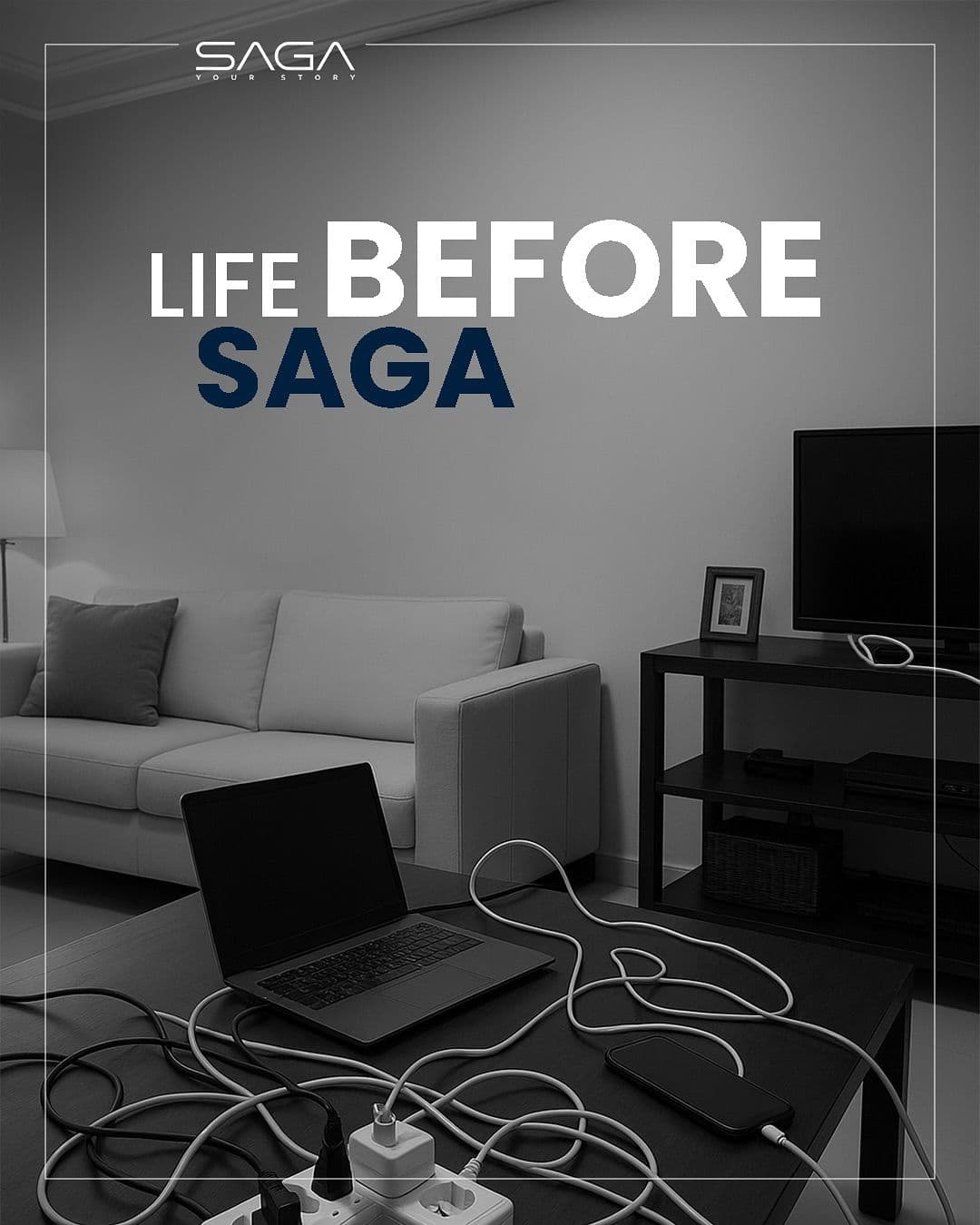
One issue is resolved by an extension cord: transferring power from one location to another. The majority of home electrical hazards and everyday annoyances stem from capacity, safety margin, and long-term adaptability, all of which it does not address. When SAGA PowerTrack and a typical extension cable are compared side by side, it becomes evident that they are not truly competing variants of the same product; rather, they are constructed to completely distinct standards.
Current and Power Capacity
Depending on the cable gauge, a common residential extension cord has a rating of 10A to 13A, which corresponds to a safe continuous load of about 2,200W to 3,000W. With a maximum power output that scales from 4,000W on the S500 to 8,000W on the S1500, SAGA's PowerTrack rail is rated at 32A for all three track lengths. Delivered by a designed rail instead of a length of flexible wire, that is more than twice the safe capacity of a typical extension cord.
When multiple devices are using power at the same time in the real world, this gap becomes especially important. Multiple devices plugged into a single strip at the end of an extension cord put all of that load via a single cable rated for a fraction of what SAGA's copper-bar rail is designed to withstand.
Number of Connection Points
An extension cord usually terminates in a set number of sockets, usually two to six, grouped together at one end of the cable. The entire length of SAGA's S1500 track may accommodate up to 15 adapters, each of which is separately rated and placed precisely where it is required rather than grouped together at a single location.
Safety Testing and Certification
The quality of extension cables varies greatly, and they are not usually independently tested to the same standards. In addition to CE and FCC certification, RoHS compliance for materials, and IEC 60884-1 certification, SAGA adapters are tested for up to 10,000 insertions. Additionally, every SAGA product is tested to a 1mm probe standard, which means that a live wire cannot be reached by an object larger than one millimetre. By default, a regular extension cord does not have any of these certifications.
Fire and Overload Risk
One known cause of electrical fires in homes is overloaded extension cables, especially when they are daisy-chained together or hidden by furniture and carpets. In addition to a fire-resistant aluminium shell that seals all internal components, SAGA's rail has integrated surge and heat protection incorporated right into the internal circuitry. Because the safety mechanisms are integrated into the infrastructure rather than relying on how neatly a cord is routed, the risk profile is essentially different.
Flexibility and Reconfiguration
By its very nature, an extension cord is disposable. When a layout changes, it is unplugged, coiled up, and transferred; when it wears out, a new one is purchased. SAGA's adapters provide the same flexibility as an extension cord without the wear, tangling, or need for recurrent purchases because they may be moved along the rail as needed without changing the underlying system.
Appearance and Everyday Use
The majority of extension cords are concealed beneath furniture or wrapped with cable ties since they are useful but rarely intended to be seen. With a finish and profile designed to sit freely along a wall, desk, or countertop rather than being hidden out of sight, SAGA's rail is constructed as an obvious architectural element.
Where Each One Still Makes Sense
Extension cords are nevertheless helpful for short-term, transient requirements, a single tool used outdoors, a one-time event setup, or a gadget that only periodically needs power in an area with no other choice. An designed rail system is always preferred over a length of wire rated for a quarter of the load for any permanent or semi-permanent power need, such as a kitchen counter, home office, shared workstation, or media console.

Final Thoughts
While both an extension cord and a modular power track provide electricity where it is needed, they are not interchangeable. Because of its greater current rating, approved safety testing, integrated overload protection, and reconfigurable design, SAGA differs from cable-and-plug accessories, which are designed for areas where power is a permanent need rather than a temporary solution.
Blog Categories
Lifestyle
Buying Guide
Planning
Safety


